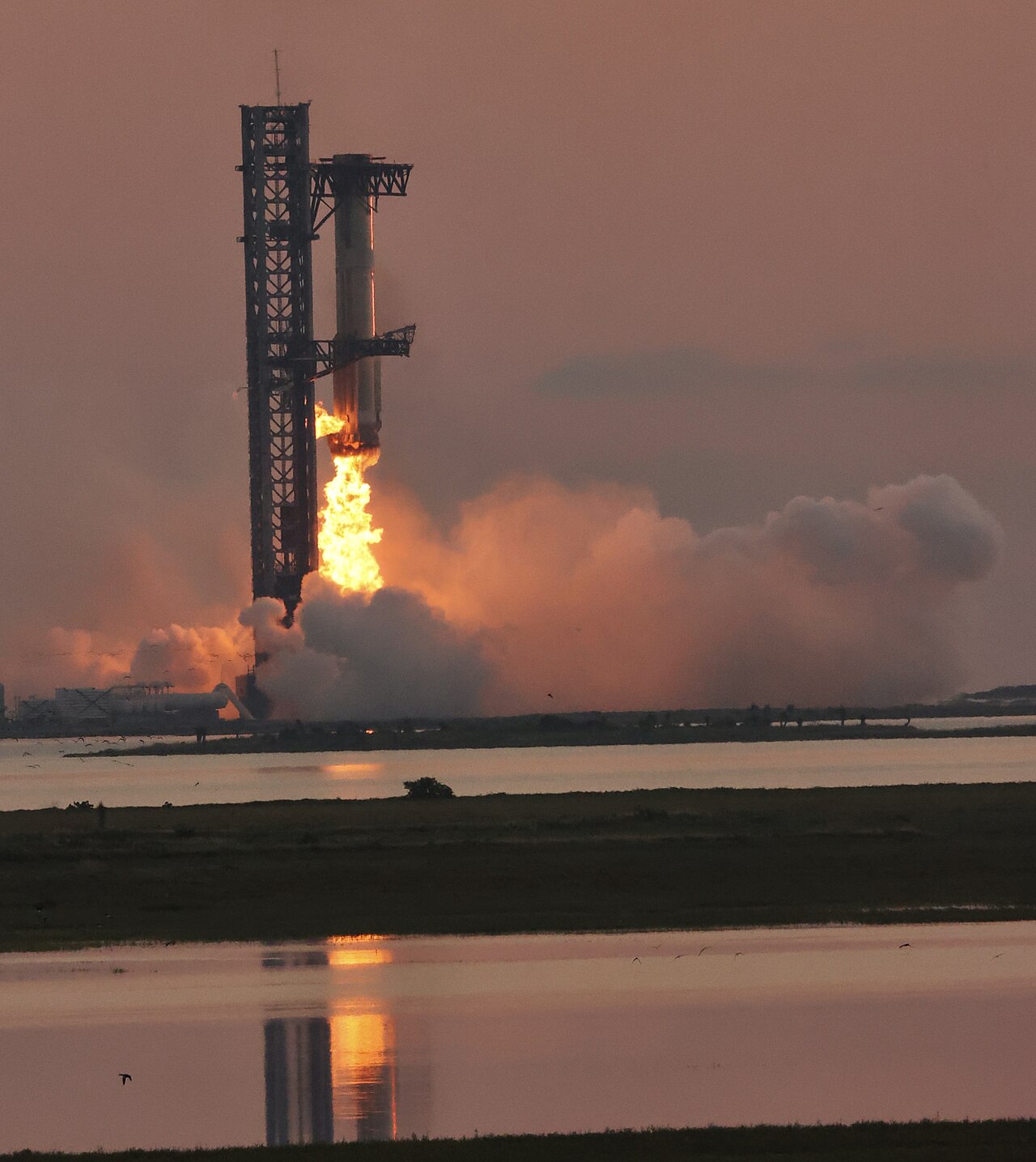

At 3:20 on Saturday afternoon, Texas time, the steel arms of a launch tower at SpaceX's Starbase closed around a falling spaceship. Ship 42, the upper stage of SpaceX's Starship rocket, had spent nearly a day in orbit before it came down into the launch tower's "chopstick" arms. "We caught a Starship, and now everything changes," SpaceX's Dan Huot said on the company's webcast, Space.com reported.
It was the first time SpaceX had caught the upper stage of Starship, the giant rocket it is building to be fully reusable. The other half of the plan failed: the Super Heavy booster, meant to be caught minutes after Friday's launch, came down in the Gulf of Mexico instead. Why is not fully settled. Huot first blamed the booster's guidance, navigation and control system, then said the next morning that the system had worked as designed: it "detected that the booster was not in the place that it was supposed to be to proceed with a catch, did an automated abort," he said, according to Space.com. In later reports, Space.com said the booster diverted after "a low-fuel alarm." The ship still deployed its load of Starlink satellites before coming home, Space.com reported.
The catch made the headlines. But the company that made it is no longer mainly a rocket company, and its filings say so. Since its stock market debut this summer, SpaceX has reported three businesses: rockets, Starlink internet service, and artificial intelligence. Last quarter, rockets were the smallest of the three. And this week, according to Bloomberg, Goldman Sachs and Apollo Global Management may start selling the debt behind SpaceX's biggest bet yet: a lease of Nvidia chips worth about $40 billion.
The rocket company, by its own numbers
SpaceX reported revenue of $14.6 billion for the quarter that ended September 30, up 161% from a year earlier, in results filed with the Securities and Exchange Commission in October. Its Space segment, the launch business that built its name, brought in $1.8 billion, up just 6%. Connectivity, which is mostly Starlink, brought in $5.2 billion, up 69%.
The AI business, which SpaceX calls SI, for "Super Intelligence," brought in $7.6 billion, up 830%. That segment holds xAI, the maker of the Grok chatbot, and the social network X, both now part of SpaceX, and Cursor, the AI coding company SpaceX bought in August at an implied value of $60 billion. Most of the jump came from renting out computing power: the 10-Q credits mainly "offering cloud services to customers for the full period and signing additional contracts during the period," along with Cursor. Its installed computing capacity reached 1.7 gigawatts, from 0.6 gigawatts a year earlier, the company said.
The company made money doing it. Net income was $4.4 billion, against a loss of $1.1 billion a year earlier.
Source: SEC EDGAR XBRL data
The $40 billion lease
On October 24, SpaceX signed what its filing calls "a binding commitment letter to enter into a master finance lease with an entity managed by Apollo Global Management, Inc." The lessor will buy graphics processing units, the chips that train and run AI, and rent them to SpaceX for "approximately five to five and one-quarter years" each. SpaceX expects principal payments over those terms to total about $40 billion. The deal is expected to close before year end, and the leases to start in the first half of 2027, when the chips arrive.
Bloomberg has reported the details the filing leaves out. A special purpose company run by Atlas SP, which Apollo backs, will buy the Nvidia chips and issue bonds backed by them. "The sale is designed to keep the debt off SpaceX's balance sheet," Bloomberg wrote, and "by using this structure, SpaceX protects its corporate credit ratings." The package, plus a US$7 billion prepayment from SpaceX, will pay for about US$47.3 billion of equipment, "namely Nvidia's latest Rubin chips," according to documents Bloomberg saw. It includes an US$8.3 billion loan for banks and several tranches of bonds for asset managers.
What makes the bonds sellable is the rent. "SpaceX's obligation to pay rent is absolute," the investor presentation said, according to Bloomberg, and "rent is owed regardless of equipment condition, casualty or force majeure, providing investors with a clean look-through to SpaceX credit." In plain terms: the chips can break, burn or sit idle, and SpaceX still pays.
Nvidia named SpaceX among the users of the same Vera Rubin systems on Tuesday. They are running at cloud partners "and coming online soon at SpaceXSI," it said in the results it filed that day. Our story on Nvidia's quarter looks at the commitments Nvidia is making to keep customers like SpaceX supplied.
Why borrow when it has cash?
SpaceX isn't short of money. At the end of September it had $51,294 million in cash and $38,561 million in short-term securities, much of it raised through its stock market debut and a bond sale at the end of June, the 10-Q shows. But it is spending fast. Its spending on property and equipment in the first nine months of the year rose by $34,223 million from a year earlier, for "data centers and related infrastructure as well as space launch facilities." Finance chief Bret Johnsen said in the results that SpaceX is "maintaining a robust, investment-grade balance sheet" while it builds.
SpaceX has leased AI hardware before. Its 10-Q shows earlier equipment leases with Valor Equity Partners, which it books as debt: $2,181 million due within a year and $10,716 million due later, at the end of September. "The founder, CEO and Chief Investment Officer of Valor, Antonio Gracias, serves as one of the directors of the Company," the filing says.
Lenders have grown more nervous. "Investors have retreated from the AI trade, questioning whether revenues can ever justify the breathtaking spend," Bloomberg reported on November 5, and the price of insurance against a SpaceX default had surged over two months "as investors grew increasingly concerned about the level of debt being taken on to fund the AI buildout." Politics has added risk: data centers became "a fierce electoral flashpoint" in this month's midterm elections, Bloomberg reported, particularly in Texas. SpaceX's own data centers are in Memphis, with more sites being developed in Mississippi.
What Starship still has to prove
Saturday's catch matters for that AI business too. Starship is how SpaceX plans to put up its next Starlink satellites, and Elon Musk has talked of a constellation of AI data centers in orbit, Space.com has reported. Musk "has said that SpaceX is targeting 10,000 Starship launches per year by 2030," Space.com reported, which would be more than one an hour.
That is a long way off. SpaceX has caught the Super Heavy booster on three earlier flights, but "it had never caught a Ship before," and it "has yet to reuse a Ship," according to Space.com. Rapid reuse, catching a rocket and flying it again within days, is what would make Starship cheap, and nobody has shown it yet with this rocket. Developing it costs money now: research spending in SpaceX's Space segment, driven by Starship, rose by $376 million, or 44.3%, in the third quarter from a year earlier.
Our read
Two things happened at SpaceX in five days, and they pull in different directions. The catch makes the rocket business cheaper in the long run, if SpaceX can turn one caught ship into routine reuse. The lease makes the AI business more expensive in the short run: a fixed bill for chips that will be about five years old when the last payment is due, owed whether or not customers keep renting the computing power.
The quarter shows why SpaceX is willing to sign it. AI revenue grew faster than anything else the company sells, and the rockets now look like the supplier to its other two businesses rather than its center. But that growth came mostly from new cloud contracts in a single quarter, and a contract can end before a lease does.
Three things in SpaceX's next filings will show how the bet is going: whether the lease closes before year end, as the company expects; the fixed rate it pays, which its filing says "will be determined at pricing"; and whether AI revenue keeps rising once the chips arrive in 2027. Saturday proved SpaceX can catch a rocket. The lease is a promise that the computing business will keep paying, and the coming year will test that.