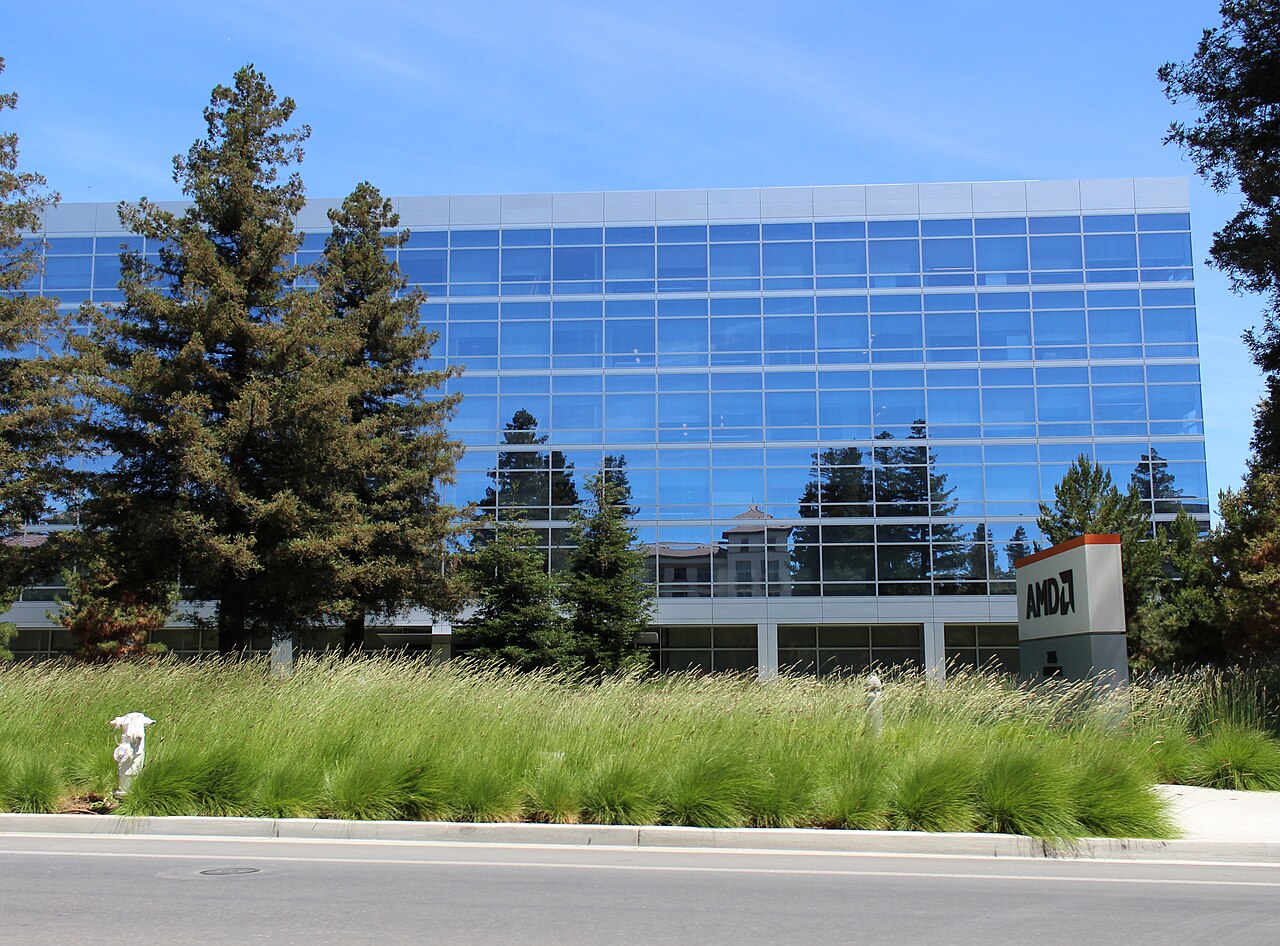

AMD has not reported its third quarter yet. On Friday its shares fell 10.88% anyway, to close at $504.80, The Motley Fool reported, the day after its oldest rival spoke. Intel said on Thursday evening that it expects fourth-quarter revenue of $15.0 billion to $16.0 billion, and its finance chief said: "we see the PC slowdown continuing at least through the first half of next year."
Earlier in the day, International Business Times, InvestorsHub and TIKR had reported the shares sharply lower, alongside a broad sell-off in chip stocks.
The reasons reported for the fall point mostly at Intel. AMD will give its own answer on Tuesday, November 3, when it reports its results. Until then, its last quarterly report, filed in August, is the best record of what the business looked like going into the quarter. Here is what it shows, and how much of it is exposed to the problem Intel described.
What the news reports said
InvestorsHub, in an article carried by Yahoo Finance, wrote that AMD's shares fell as "a disappointing outlook from rival Intel (NASDAQ:INTC) raised concerns about weakening demand across the personal computer and semiconductor markets." It explained the link this way: "AMD competes directly with Intel in the market for PC processors, making developments in Intel's business an important indicator of broader industry conditions."
International Business Times put it more bluntly: "AMD is Intel's main competitor in x86 processors, the chips that power most PCs and many servers. That means Intel's gloomy view of the PC market lands directly on AMD." It named two more reasons. One was Intel's own strength in servers, which "raised questions about competitive pressure on AMD's EPYC server chips, a key growth driver for the company." The other was the market around it: "AMD was also hit by a broader retreat from AI-linked stocks." The publication added: "Analysts said the PC demand concerns escalated ahead of AMD's report."
TIKR, writing on Yahoo Finance, listed AMD among the companies that dropped with Intel: "Dell, HP, AMD and Micron fell too, as Intel blamed high memory prices for the PC slowdown." It also noted that the picture is not one-sided, since AMD "shares the PC squeeze, but it's also Intel's main server rival." It cited a JPMorgan estimate that Intel's share of server processor revenue has fallen from 77% to 53% since late 2022.
These are the reasons the news organizations gave. We don't know why any one investor sold, and a single day's move says little about a company's business.
What Intel said
Intel's quarter itself was strong, by its own account. Its earnings release, filed with the SEC on Thursday, shows third-quarter revenue up 21% from a year earlier, to $16.5 billion. Its data center and AI unit, which sells the Xeon server chips that compete with AMD's EPYC line, grew 78%, the release shows.
The news reports pointed to the forecast instead. Intel's shares tumbled on Friday "after the chipmaker's forecast for the final three months of the year came in well short of Wall Street's expectations," Yahoo Finance reported. The cause Intel gave is in the PC market. Yahoo Finance summed it up: "AI data centers are soaking up the world's memory chips, pushing up prices for laptops and desktops. Intel now expects PC shipments to fall about 12% this year and another 10% in 2027."
Intel's chief executive, Lip-Bu Tan, struck a different note in the release: "Despite near-term headwinds across the PC industry, demand for our CPUs remains robust." Its chief financial officer, David Zinsner, was the one who set the time frame:
"Looking ahead, we see the PC slowdown continuing at least through the first half of next year, but we remain optimistic about the opportunities across our broader portfolio," Zinsner said.
What AMD looked like going into the quarter
AMD's last quarterly report, its 10-Q for the three months to June 27, shows a company growing fast. Net revenue was $11.5 billion, a 50% increase from a year earlier. Net income for the quarter was $2.3 billion, up from $872 million a year earlier.
For a sense of scale: in all of 2025, AMD's revenue was $34.6 billion, up from $25.8 billion in 2024, and its net income was $4.3 billion, its annual reports show.
Source: SEC EDGAR XBRL data
Most of that growth came from data centers, not PCs. Data Center revenue was $6.7 billion in the quarter, up 107% from $3.2 billion a year earlier. In the earnings release, AMD's chief financial officer, Jean Hu, said the business "represented 58% of company revenue in the quarter."
The PC business is the part Intel's warning touches most directly. AMD reports it as "Client" revenue, the processors inside desktops and laptops. It was $3.1 billion in the quarter, up 23% from $2.5 billion. The 10-Q says that growth was "primarily driven by a 34% increase in unit shipments of client processors, partially offset by a 6% decrease in average selling price of client processors." In other words, AMD was selling many more PC chips, at slightly lower prices on average.
Gaming, which includes the chips AMD designs for game consoles, went the other way: its revenue fell 31% to $779 million, "primarily due to lower semi-custom revenue." Embedded chips, built into other companies' equipment, grew 19% to $977 million.
The memory problem was already in AMD's filing
The cause Intel gave for the PC slump, expensive memory, is not news to AMD. Its 10-Q, filed in August, warns of it in its list of risks: "For example, there is currently an industry-wide memory shortage as the demand for such components has outpaced supply. The price of memory has also increased as a result of the shortage."
The same filing says what the PC business depends on: "Our Client and Gaming segment revenue is focused on the consumer desktop and notebook PC segments and will depend in part on the market's adoption of AI PCs." If memory makes laptops and desktops dearer and fewer of them are sold, fewer of the processors inside them are needed too. That is the chain Intel described on Thursday.
What AMD said to expect
AMD gave its own forecast in August. Its earnings release says that for the third quarter it "expects revenue to be approximately $13 billion" give or take $300 million. Hu added: "We expect Data Center sales to accelerate in the second half of 2026, driving stronger overall revenue growth and continued earnings expansion."
That forecast covers the three months that ended in September. The question the news reports raised on Friday is about what comes after: whether AMD sees the PC slowdown that Intel sees, and for how long.
Our read
This is analysis, not advice. Intel's warning was about PCs, and AMD's filings show that PCs are now a smaller part of its business than data centers. In the June quarter, Client revenue was less than half of Data Center revenue. A long PC slump would still hurt: Client revenue was the second-largest line, and it was growing because AMD sold many more chips, which is exactly what a shrinking market makes harder.
The server side cuts both ways, as the reports noted. Intel's data center unit is growing fast again, which is competition for AMD's EPYC chips. But Intel's chief executive also said the company's "immediate priority is to unlock additional supply to meet extraordinary demand for our Xeon family," which means it cannot yet make all the server chips customers want. Customers who can't wait have another supplier in AMD.
None of this tells us AMD's third-quarter numbers. Those come on Tuesday. "AMD (NASDAQ: AMD) announced today that it will report fiscal third quarter 2026 financial results on Tuesday, Nov. 3, 2026, after the market close," its October 6 announcement says. What to watch then is in AMD's own words: what it says about PC demand and memory prices, and whether data centers are still carrying the company. Until then, the news reports tie Friday's fall to what Intel said, not to anything AMD has reported.