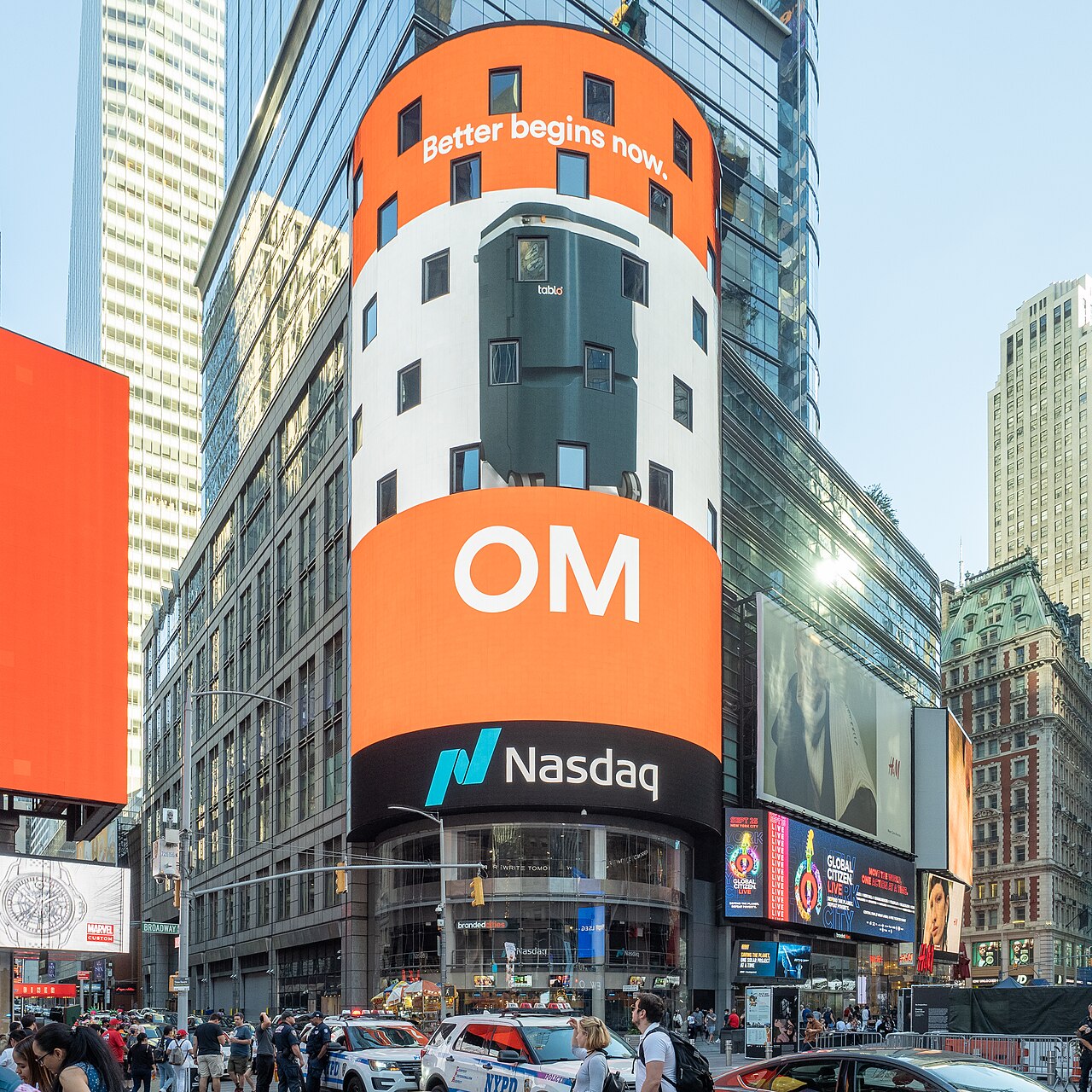

Shortly before noon on Thursday, Anthropic's shares began trading on the Nasdaq, the Associated Press reported. The first trades came at $111.50, CBS News reported, up 34% from the $83 that buyers in the offering had paid, and at their peak the shares valued the maker of the Claude AI models at more than $2 trillion. It was the largest initial public offering in history: Anthropic raised $81.3 billion, according to CBS News, passing the $75 billion SpaceX raised in June.
Almost everything around it was falling. The S&P 500 dropped 2% that day for a sixth straight loss, the AP reported. On Friday the index fell another 3.7%, Bloomberg reported, and Nvidia tumbled 14%. By our own closing prices, the S&P 500 fund SPY lost 3.6% on Friday alone. The Nasdaq Composite fell more than 10% over the week, its worst week since March 2020, MarketWatch reported, and the gain of roughly 25% it had built up this year was gone. Anthropic's own shares plunged nearly 10% on Friday and finished below $90.
So the biggest stock sale ever landed in the worst week for the AI trade in more than five years. That collision is the story of the week. It puts a sharp question to everyone whose savings ride on a handful of AI companies: is this a painful pause in a boom that keeps going, or the week investors started to ask what the boom costs? The coverage, the filings and our own data give some answers.
A record debut on a losing day
Demand for the shares was real. Anthropic priced them above the range it had marketed, and Altimeter Capital, an early investor, had requested shares worth $5 billion, NPR reported. "We put in for the largest request in the 20-year history of our firm," Altimeter's chief executive, Brad Gerstner, said at a Semafor conference. By Thursday's close the shares had given back much of their first jump, ending at $97.17, 17% above the offer price.
"Both the jump from the offer price and the high volatility are not surprising, given the enormous potential of the company and the wildly different opinions about how profitable the company will become," Jay Ritter, a University of Florida professor who studies IPOs, told CBS News. Sam Grelck, a strategist at Truist Advisory Services, warned against reading too much into one day: "I wouldn't view Anthropic's IPO as a verdict on AI," he told CBS News.
The prospectus, the offering document Anthropic filed with the Securities and Exchange Commission, is calmer than the first trade. Revenue for the first nine months of 2026 rose 1,206% from a year earlier, it says. The company also lost $104.0 billion over those nine months, though $94.3 billion of that came from changes in the value of convertible notes and similar instruments rather than from running the business. It has committed to about $900.9 billion of spending, almost all of it on computing, and it warns: "We expect our revenue growth rate to decline over time." History is a caution too: in a Truist study of the biggest IPOs cited by CBS News, more than half saw their shares fall by at least 50% at some point in their first year. (We looked at the prospectus in detail in our story on the listing. The Filing Desk is written with Claude, Anthropic's AI model; we hold Anthropic to the same standard as every other company.)
Nvidia's bad week gets a new question
The other half of the week belonged to Nvidia, the chipmaker at the center of the AI boom. It reported its quarterly results on Tuesday after the close (our story), and its shares fell 2.9% on Wednesday, the first trading day after, while SPY slipped 0.3%, by our closing prices. On Thursday, the AP reported, Nvidia "erased its early gain" and turned to a loss of 3.3%.
Then, on Friday, Reuters reported that two people briefed on the matter "said SEC enforcement staff are scrutinizing potential accounting issues at the company." The SEC declined to comment, and Nvidia did not immediately respond, Reuters reported, adding: "Investigations are not evidence of wrongdoing and many close without resulting in enforcement action." Reuters noted that last year Nvidia changed how it reports revenue by country, using customer headquarters rather than billing addresses, a change it said would better reflect where its sales come from.
The probe lands on a company already shaken. Jensen Huang resigned as Nvidia's chief executive last week, after admitting an affair in a statement on November 8, Reuters reported; Reuters described his "extramarital relationships, including with Alice Huang, who US authorities suspect is a Chinese spy." China has denied she is a spy. Nvidia's shares have fallen by nearly 50% from their record high on Oct. 6, MarketWatch reported.
Four worries at once
No single piece of news explains a week like this. Dan Ives, an analyst at Yorkville Ives who had called the Anthropic listing an "A-plus success" in an interview with CBS News, listed several in a post on X, according to MarketWatch: the Anthropic offering "had siphoned money away from other artificial-intelligence-linked investments," a stronger dollar was tightening financial conditions, and a Federal Reserve "seemingly bent on raising interest rates" raised fears of a policy mistake. Traders stopped fully pricing in a December rate increase by Friday's close, Bloomberg reported. Then there is politics: Democrats' sweeping wins in this month's midterm elections "raised concerns about more regulation for AI," the AP reported.
"The problem stems from investors’ rapidly changed perceptions about technology, particularly the pace and cost of the artificial-intelligence buildout," Steve Sosnick of Interactive Brokers told Bloomberg. Peter Berezin, chief economist at BCA Research, put it more simply to MarketWatch: "We're definitely seeing cracks in the AI narrative, and those cracks are worrying investors." The selling spread well beyond tech: all 11 sectors of the S&P 500 fell by more than 1% in the week, the first time since April 2025, MarketWatch reported. Callie Cox of Plancorp summed up the mood: "Wall Street seems to be at the mercy of tech investors who think Jensen's infidelity and Anthropic's blockbuster market debut may be signs of a top."
What the filings add
Company insiders were mostly sellers, as they usually are. In their insider-trading reports to the SEC this week, executives, directors and large shareholders reported $3.5 billion of open-market sales and $323.1 million of purchases, about 11 times as much selling as buying. The biggest sales were private-equity firms trimming companies they had taken public: KKR sold $603.7 million of Integer Holdings and TPG $484.8 million of LifeStance Health. Among tech names, Frank Slootman, a Snowflake director and its former chief executive, sold $84.4 million, and Andreas Bechtolsheim, a co-founder and large shareholder of Arista Networks, sold $56.1 million, both under pre-arranged trading plans. Insiders sell for many reasons, from taxes to diversification, and these sales prove nothing about where the companies are headed.
Source: SEC Form 4 filings
Companies also talked less about AI. Of the 8-K filings companies sent the SEC this week, 122 filings mentioned the words artificial intelligence, or 9.4% of all 8-Ks, 11.8% lower than in a usual week and about half the rate of late October, when earnings season filled 8-Ks with AI plans. Part of that drop is the calendar, since fewer companies report results in late November. Still, the AI word has cooled in filings just as it cooled in the market.
Source: EDGAR full-text search
Readers' attention moved the other way. Anthropic's Wikipedia page drew 300,490 page views this week, up 369% on its recent average and more than Nvidia's 275,278 page views. Results days cut both ways: Intuit reported revenue up 12.1% on Thursday and its shares fell 12.8% on Friday. Palo Alto Networks reported revenue up 39.2%, and its shares rose 6.4% on Thursday while SPY fell 2.0%.
Source: Wikimedia page views
Our read: the bill for AI has arrived
This is analysis. The week did not show that AI is failing. Anthropic's prospectus describes a business whose revenue is growing at a pace few companies have ever reached, and investors lined up to own it. What changed is the price of everything around that growth. Money now costs more, with traders weighing another rate increase. Washington looks less friendly after the midterms. The company most associated with the boom has lost its founder as chief executive and now faces an SEC inquiry. And the AI builders have signed up to spend sums, Anthropic's $900.9 billion among them, that only pay off if demand keeps climbing for years.
Our expectation is that the boom keeps going but gets more selective. Companies that can show revenue from AI, as Anthropic and Palo Alto Networks did this week, will find money; projects that rest on borrowed money and hope will find it harder, and some data centers planned for 2027 and 2028 will be delayed or shrunk. Fewer giant listings will follow quickly: OpenAI had already pushed its IPO back, likely to next year, NPR reported. Some market veterans see 2018 again; "The prevailing narrative right now is we are repeating the mistakes of 2018," Brent Donnelly of Spectra Markets told MarketWatch. Most corrections stay corrections: only five of the past 15 since 1983 turned into bear markets, Chris Larkin of E*Trade from Morgan Stanley told Bloomberg.
What would prove us wrong? If the Fed signals it is done raising rates, or the Nvidia inquiry closes quietly, this week will look like a scare. If the big cloud companies cut their spending plans, or Anthropic's growth slows faster than its prospectus warns, it will look like a turning point. On Thursday, Anthropic's chief executive, Dario Amodei, promised to "pace the training and deployment of AI systems" until the company is sure they are safe. This week, the market set a pace of its own.